

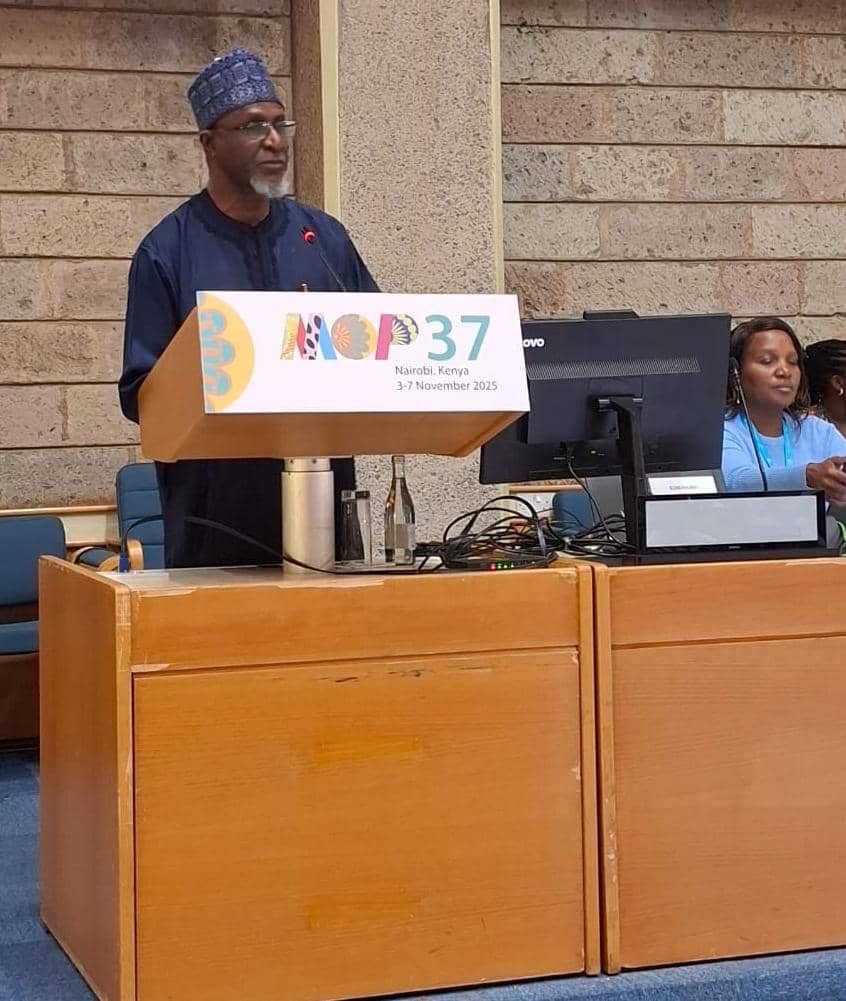
At the High-Level Segment of the 37th Meeting of the Parties to the Montreal Protocol on Substances that Deplete the Ozone Layer, held in Nairobi from 3–7 November 2025, Nigeria reiterated its strong commitment to ozone-layer protection and climate action. Speaking on behalf of President Bola Ahmed Tinubu, GCFR, Minister of Environment Balarabe Abbas Lawal conveyed Nigeria’s congratulations to the newly elected President of the meeting and commended the Government and people of Kenya for hosting the event.
The Minister reviewed Nigeria’s sustained national ownership and leadership in implementing the Vienna Convention and the Montreal Protocol. Over recent decades, Nigeria has implemented policies, regulations and projects to phase out ozone‑depleting substances (ODS). Working closely with partners including UNDP, UNIDO and the Multilateral Fund, the country has successfully transitioned away from chlorofluorocarbons (CFCs) and halons and has advanced implementation of Stage II and III of its HCFC Phase‑out Management Plan in line with global commitments.
Capacity building and industrial conversion have been central to Nigeria’s efforts. The government has upgraded 23 refrigeration and air‑conditioning training centres with modern tools and equipment, strengthening safe and efficient servicing practices and training more than 1,200 technicians. In addition, two major air‑conditioner manufacturing lines were successfully converted and commissioned during the year. These measures have enabled Nigeria to achieve and even surpass its 2025 national phase‑out target under the Protocol.
Following Nigeria’s ratification of the Kigali Amendment in 2018 and the approval of Stage I of its Kigali Implementation Plan at the 95th Executive Committee meeting in December 2024, the country has initiated actions to reduce hydrofluorocarbon (HFC) consumption by 10.13% from baseline levels. Minister Lawal indicated that Nigeria looks forward to the Meeting of the Parties’ endorsement of its revised HFC baseline consumption in line with the recommendations of IMPCOM at its 74th meeting. Such endorsement would facilitate access to additional funding needed to accelerate HFC phase‑down consistent with the Kigali targets for Article 5, Group 1 parties.
The Minister also used the platform to highlight ongoing challenges. He warned that unmanaged emissions of controlled substances and growing banks of used ODS and HFCs—particularly in developing countries—could undermine decades of environmental gains. To address these risks, Nigeria called for enhanced international cooperation, technology transfer and adequate funding mechanisms to support Article 5 parties in sustainably managing legacy stocks and preventing future emissions.
Minister Lawal congratulated additional Parties that have ratified the Kigali Amendment and urged remaining countries to do so promptly. He emphasized that collective decisions and concerted action are essential to safeguard the climate and ensure an equitable, effective HFC phase‑down so that no nation is left behind.
In closing, the Minister commended the President of the Bureau and the Ozone Secretariat for their leadership and the organization of the meeting, reaffirmed Nigeria’s commitment to continued compliance with the Montreal Protocol and its amendments, and wished delegates fruitful deliberations at MOP37.