
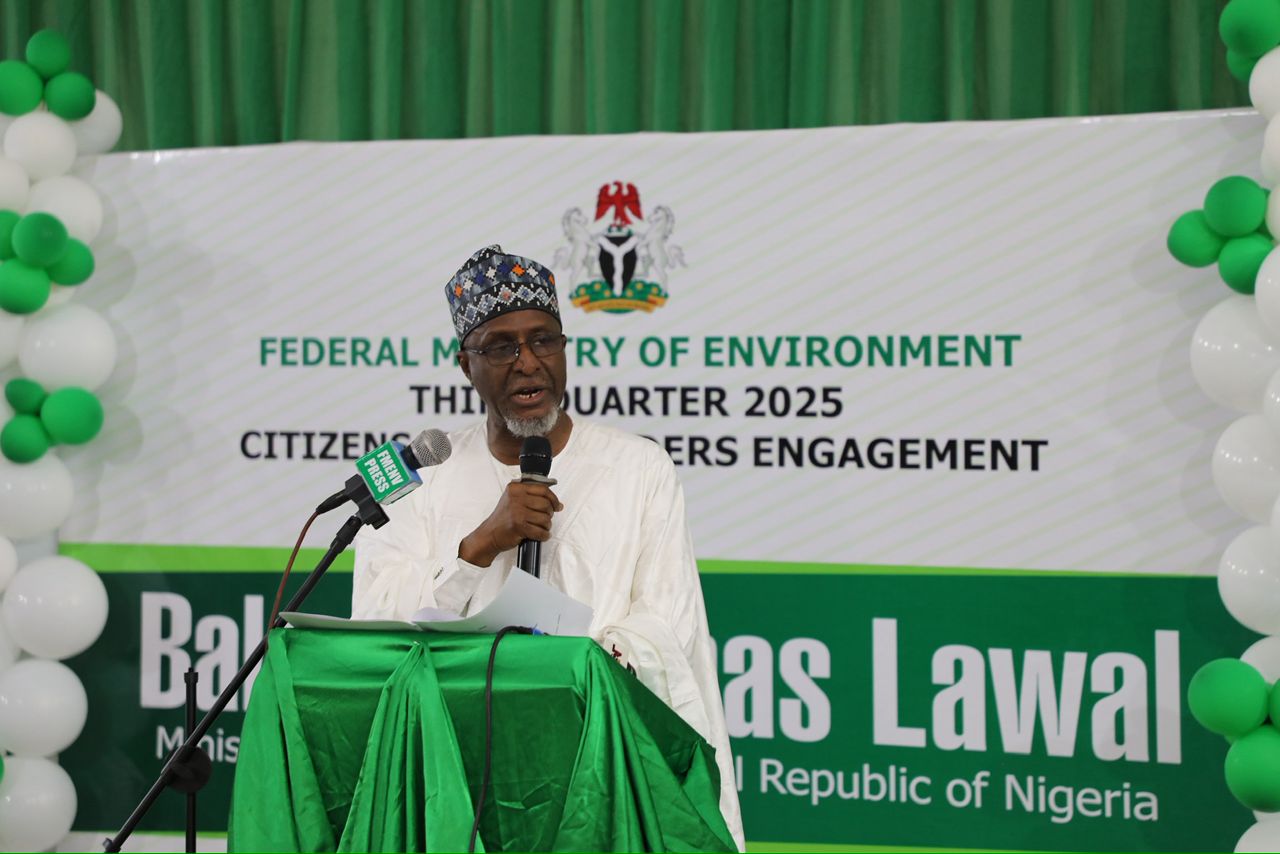
Minister of Environment Malam Balarabe Abbas Lawal today presented a progress report on the Federal Ministry of Environment’s achievements since May 2023 at the Third Quarter 2025 Citizens/Stakeholders’ Engagement held in Maitama, Abuja. Framed within President Bola Ahmed Tinubu’s “Renewed Hope Agenda,” the presentation showcased advances across forestry, land restoration, climate adaptation, pollution control and community resilience.
Forestry and afforestation efforts recorded significant gains, with over 10 million trees planted nationwide since 2023. The Ministry plans to scale this up in 2025 with a target of 25 million drought‑resistant seedlings (including date palm and neem) for 11 northern states, and has established 195 km of shelterbelts to combat desertification. Renewable‑energy and efficiency interventions include 5,253 mini solar systems, 4,602 solar streetlights and distribution of 6,600 improved cooking stoves. The Ministry is also promoting sustainable alternatives such as bamboo processing in Kogi and strengthening transboundary conservation through an MoU with Cameroon.
Through the ACReSAL project, 978,235 hectares of degraded land were restored across 19 northern states and the FCT, supporting livelihoods and agricultural productivity. A USD 9.025 million Community Revolving Fund has reached thousands across 361 communities, while mechanisation support — including tractors and hand tillers — has benefited tens of thousands of farmers. Nigeria’s engagement with regional initiatives such as the Middle East Green Initiative and planned participation in the World Bank’s West Africa Coastal Areas program further broadens cooperation on resilience and renewable energy.
On flood and erosion control, the Ministry reported a 90% accuracy rate from automated Flood Early Warning Systems (FEWS) and completion of 238 major gully‑control projects nationwide. A EUR 175 million (approx. USD 200 million) financing package from the European Investment Bank for the Nigeria Climate Adaptation, Erosion, and Watershed Project (NEWMAP‑EIB) is set to launch on 30 September 2025 to strengthen protections for vulnerable communities.
Major strides were also reported on pollution control and environmental health. The Federal Executive Council approved a ban on single‑use plastics in federal MDAs (June 2025). A $2.9 million plastics recycling facility was commissioned in the FCT, reverse vending machines were introduced, and the Circular Economy Roadmap has reportedly generated over 750,000 jobs, largely for women waste pickers. In Ogoniland, HYPREP has remediated 918.75 hectares of shoreline, planted 1.41 million mangrove seedlings, and provided employment for some 7,000 locals, with water treatment plants and a 100‑bed specialist hospital nearing completion. The Ministry, with UNIDO support, is phasing out ozone‑depleting substances and piloting eco‑friendly refrigeration systems in Lagos. NOSDRA certified 1,331 remediation sites and rolled out a satellite‑based methane emissions tracker for the oil and gas sector.
Climate action and financing initiatives continue to advance: the National Clean Cooking Policy (April 2024) aims to distribute 30,000 clean cookstoves; eight states have finalized climate policies following the Sub‑National Climate Governance Ranking; a renewable energy agreement with China was signed at COP29 in Baku; and a National Adaptation Plan informed by a Climate Risk and Vulnerability Assessment is slated for presentation at COP30. Financial instruments include a ₦50 billion Green Bond issued in June 2025, with a ₦300 billion issuance planned later in the year.
On regulatory oversight and biosafety, the Ministry issued 1,966 Environmental and Social Impact Assessment permits, while the National Biosafety Management Agency trained 1,470 personnel and accredited institutions for GMO research. NESREA gazetted 33 regulations in 2023, inspected 1,671 sites and issued some 1,800 environmental permits.
Looking ahead, the Ministry plans to expand afforestation campaigns, establish environment clubs in secondary schools, and deepen participation in regional coastal erosion and climate resilience initiatives. The engagement highlighted a comprehensive, multi‑sector approach aimed at consolidating recent gains and mobilising finance, partnerships and community participation for a more sustainable and resilient Nigeria.