
By Kio Amachree
Nigeria is drifting, and everyone can see it.
The country is formally led by Bola Tinubu, a man rarely present, visibly frail, and widely perceived as disengaged from the daily demands of governing a complex federation of more than 200 million people.
Power abhors a vacuum. In Nigeria, that vacuum has been filled by regional strongmen, most visibly Nyesom Wike, whose public theatrics, patronage politics, and property largesse have become a symbol of a rudderless state.
This is not merely a leadership problem. It is a structural one.
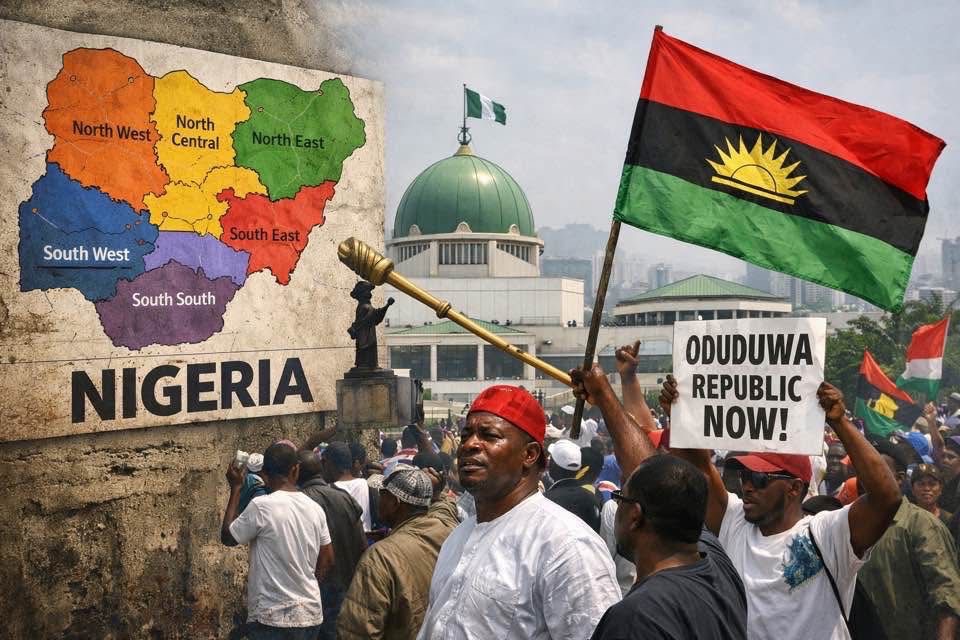
Nigeria is a British-made union held together by administrative force rather than shared consent. The arrangement has always been uneasy. Today, it is openly contested. Many in the South believe the federation is rigid by design and tilted in favor of the North. The Igbo question remains unresolved, with renewed calls for Biafra reflecting deep political alienation rather than nostalgia. Among the Yoruba, talk of autonomy is no longer whispered in private rooms but discussed openly in civil society and elite circles.
These are not fringe views. They are symptoms of a federation that no longer commands emotional loyalty across its constituent parts.
The argument against a referendum has always been fear. Fear of fragmentation. Fear of instability. Fear of opening a Pandora’s box that cannot be closed. But refusing to ask the question does not make the problem disappear. It simply allows resentment to harden and politics to become more cynical, more transactional, and more tribal.
Nigeria today lacks the one thing that has historically held fragile unions together: strong, credible, and present leadership. Without it, appeals to national unity ring hollow. Tribalism fills the space where trust in institutions should live. Regional loyalty replaces faith in the center. Governance becomes theater.
A referendum does not automatically mean dissolution. It can also be a mandate for restructuring. A chance to renegotiate the terms of coexistence. A peaceful, democratic mechanism to test whether Nigerians still believe in the current union, and if not, what kind of union they are willing to sustain.
The danger is not asking the question too soon. The danger is waiting until the answer is imposed by chaos rather than choice.
Nigeria stands at a crossroads. Strong leadership could still stabilize the present arrangement. But in its absence, pretending that the cracks are not widening is the most dangerous illusion of all.
History shows that unions survive on consent, not denial.
Hashtags